REVIEW · WORKSHOPS
Thangka Painting Workshop
Book on Viator →Operated by Queermandu | Gay Tours Nepal · Bookable on Viator
A thangka workshop turns a souvenir into a story. I like that you learn the traditional process with skilled artists (not just buy a mystery print), and you get to choose one design out of three while also picking your pickup location and timing. One thing to consider: if you’re already a practiced painter, the first stretch may feel more like guided coloring than deep, hands-on technical instruction.
In practical terms, this is a 4–5 hour studio session, built around watching, asking questions, and then making your own finished thangka to take home. You’ll ride in an air-conditioned vehicle, and you’ll have at least one English-speaking guide on hand the whole time. In one account, the guide named Aayam helped make the session feel personal and question-friendly.
The main drawback for some people is simple: snacks aren’t included, so you’ll want to plan food around the midday start and the time in the workshop. If you’re ready for a focused afternoon and don’t mind sitting for stretches, this is an excellent way to get real quality (and context) before you ever shop for art.
In This Review
- Key highlights you’ll care about
- Pickup to the studio: how this fits into a Kathmandu afternoon
- Choosing one of three thangka designs (and why that’s the point)
- Inside the workshop: what you’re really learning
- Painting session flow: how the class usually unfolds
- The guide experience: questions, clarity, and the role of someone English-speaking
- Take-home value: leaving with a real souvenir, not just a photo
- Price and value: is $72 per person fair for what you get?
- Who should book this workshop (and who might want to think twice)
- Should you book the Thangka Painting Workshop?
- FAQ
- Where is the thangka painting workshop located?
- How long does the workshop take?
- What time does the experience start?
- Is pickup from my hotel included?
- Can I choose what design I paint?
- Is there an English-speaking guide?
- Is this tour private?
- What’s included in the price, and what isn’t?
- What are the cancellation rules?
Key highlights you’ll care about
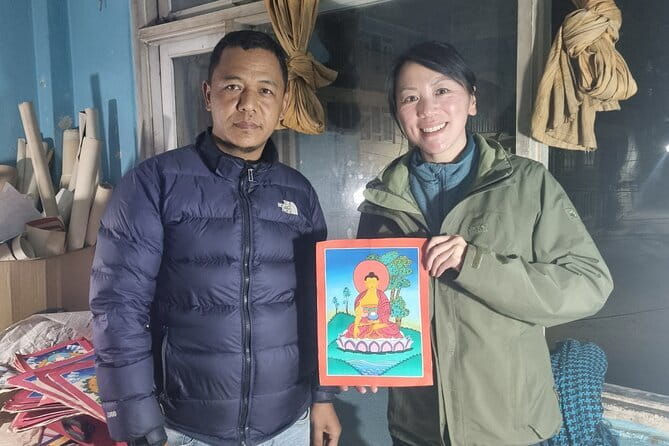
- You choose your design from 3 options, so you’re not stuck with whatever’s available.
- You learn the full process, instead of just watching a quick demo and leaving with a finished product.
- Patient instruction matters here, including help correcting mistakes as you go.
- Real studio energy: master artists work alongside apprentices, so you see how the tradition is taught.
- Midday timing + pickup options make it easier to slot into a Kathmandu day without chaos.
Pickup to the studio: how this fits into a Kathmandu afternoon
This workshop is scheduled to start at 12:45 pm, and it runs roughly 5 hours total. The timing is helpful if you want an activity that breaks up a travel day without requiring an early wake-up or a late-night push.
Logistically, pickup is offered, and you can choose where you’re picked up. That matters in Kathmandu, where “getting there” can be the hardest part. The meeting point is described as being near public transportation, which gives you a backup plan if you’d rather handle part of the trip independently.
You’ll travel by an air-conditioned vehicle, and the whole setup is designed as a private tour/activity for your group—so you’re not squeezed into a large crowd while you’re trying to ask questions or work at your own pace.
One more practical note: you’ll likely be sitting and concentrating for much of the session. The experience is listed with a moderate physical fitness level, so it’s best for people who are comfortable with sustained sitting and basic mobility.
You can also read our reviews of more tours and experiences in Kathmandu


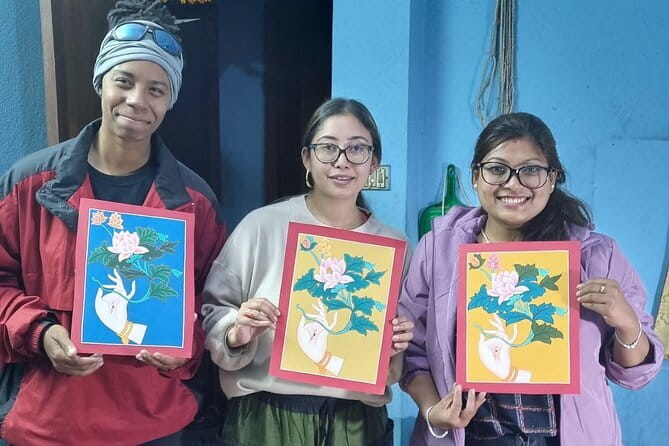
Choosing one of three thangka designs (and why that’s the point)
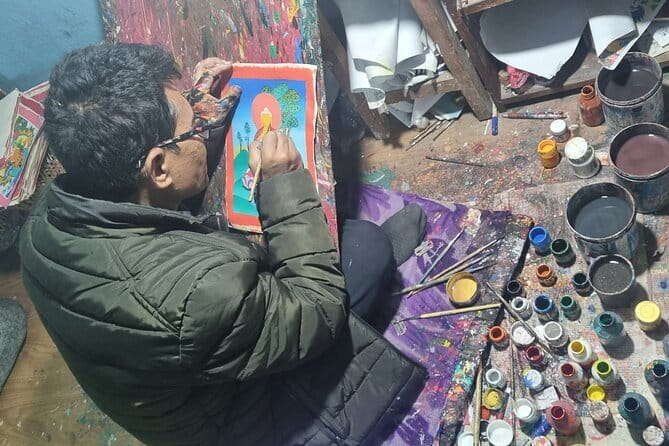
You don’t just arrive and hope it works out. A major quality-of-life feature here is that you choose one design out of three, and you can pick timing that works for your day.
That choice changes your experience in two ways:
- Motivation: You’ll care more about the final result when you actually picked the motif.
- Guidance: Your artists can steer your process toward the design you selected, so the class feels directly tied to what you’ll take home.
This is also where the workshop’s whole philosophy shows up. Instead of buying art from a random shop corner—where you might not even know whether something is hand-printed or machine-printed—you’re making a piece with artists who can explain what you’re seeing and doing. The value isn’t only the object. It’s the understanding.
Inside the workshop: what you’re really learning
The core of the experience is learning how to paint a traditional thangka with a set of artists in their workshop. The session is described as 4–5 hours, and you’re not just a spectator. You’re part of the process, from your first steps to finishing your own souvenir.
Here’s what I think makes this more meaningful than a quick craft stop: it’s not framed as a single lesson or a fast souvenir assembly line. You’re there to observe the process and ask questions about the artform while you work.
From the feedback, the teaching style seems to be a big part of the satisfaction:
- One account highlights a master who is patient and stays with you throughout the process.
- Another notes that apprentices and master artists were working in the same studio space, so you see tradition passing hands and skills building gradually.
And yes—if you make a mistake, instruction is meant to keep you moving. People specifically mention getting help correcting errors rather than being rushed off to the next step.
Painting session flow: how the class usually unfolds
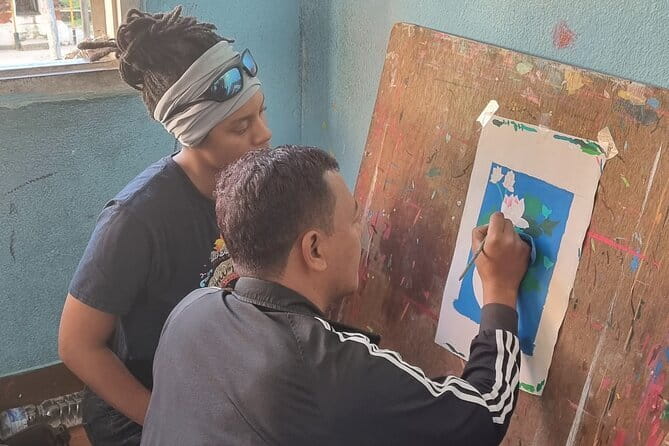
Even without a stop-by-stop list, you can count on the session having a clear rhythm because it’s built around you producing a take-home thangka.
A typical flow looks like this:
- Orientation and setup: You’ll get into the workshop atmosphere and begin your design work with the artists guiding you.
- Guided painting: You follow instructions and paint your piece using the studio’s approach for a traditional thangka.
- Coaching and corrections: As you work, the master (and the surrounding team) helps you adjust when needed.
- Finishing: The session ends with you taking home the thangka you made.
One review adds a nuance that’s worth repeating. If you’re a painter already, you might feel that after a couple hours, you’re mostly doing coloring and execution rather than new theory every minute. In other words: it’s a great guided practice session, but it may not feel like a long, technical art masterclass for someone searching for heavy instruction on composition or symbolism.
The guide experience: questions, clarity, and the role of someone English-speaking
This activity includes one English-speaking guide to help you throughout. That’s more useful than it sounds, especially for a form like thangka where the art carries specific methods and cultural meaning.
If you like to ask questions—and most people do once they see how precise the work is—having an English-speaking go-between makes a real difference. It also reduces the awkward feeling of wanting to learn but not knowing how to phrase the question.
One piece of feedback specifically calls out Aayam as helping personalize the session. While experiences can vary day to day, the overall pattern from the accounts is consistent: instruction and patience help you feel comfortable enough to keep going, even when corrections are needed.
Take-home value: leaving with a real souvenir, not just a photo
The biggest payoff is simple: you take the thangka souvenir you made. For me, that’s the key metric for choosing a workshop like this. A store purchase can be pretty, but you don’t always know the difference between handwork and mass printing. Here, you see the craft happening and you produce the piece yourself.
That matters when you shop in Kathmandu. Once you’ve watched a traditional process up close, you’re better equipped to spot quality and understand why a more careful piece costs more than a cheap one. Even if you still buy art later, you’ll have a baseline for what “authentic process” looks like.
Practical tip: because you’re taking home a painted work, plan your day so you’re not cramming in messy activities right after. You’ll want a calm route back to your hotel, and you’ll want to be mindful about keeping your new artwork protected.
Price and value: is $72 per person fair for what you get?
At $72.00 per person, this workshop sits in the “worth it if you actually participate” category. If all you wanted was a quick craft demo, you’d probably look elsewhere. But you’re paying for three things that justify the cost:
- A real workshop setting with skilled artists (including master artists and apprentices working together).
- Instruction with correction, not just a one-way class where mistakes are ignored.
- A take-home product made by your own hands, with context attached.
Also, the class length is a full afternoon chunk (about 5 hours). That time isn’t just sitting around. It’s enough to make something you can be proud of.
One more value detail: you’ll travel by air-conditioned vehicle and get all fees and taxes included. That reduces the common travel headache of surprise add-ons.
Who should book this workshop (and who might want to think twice)
This thangka painting experience is a great fit if you:
- Want a Kathmandu activity that’s hands-on and culturally grounded.
- Prefer quality you can verify by understanding the process.
- Enjoy patient guidance and don’t mind learning through doing.
It’s also a good pick if you’re traveling with a group and want a private setup where you can ask questions without being rushed.
You might want to think twice if:
- You’re the type who wants a very long, intensive art theory lecture. The pacing may feel like focused execution rather than constant new concepts.
- You hate workshops that take most of your afternoon. This one is built for 4–5 hours of steady work.
- You don’t plan meals well. Snacks aren’t included, so you’ll want to eat beforehand or handle snacks on your own.
Should you book the Thangka Painting Workshop?
If you’re choosing between buying a thangka and learning how one is made, I’d book this. The combination of patient instruction, real workshop atmosphere, and the fact that you take home the finished piece makes the experience feel like more than a souvenir factory.
I’d especially recommend it if you’re the kind of traveler who wants to understand what you’re buying. After this, you’ll be able to look at thangkas with a sharper eye for craftsmanship—and you’ll have your own artwork to remind you of the process, not just a name on a tag.
If your schedule allows, it’s one of those Kathmandu activities that turns a day trip into something you can keep.
FAQ
Where is the thangka painting workshop located?
It’s in Kathmandu, Nepal.
How long does the workshop take?
The class is about 5 hours (roughly 4–5 hours).
What time does the experience start?
The start time is 12:45 pm.
Is pickup from my hotel included?
Pickup is offered, and you can choose your pickup location.
Can I choose what design I paint?
Yes. You can choose one design out of three.
Is there an English-speaking guide?
Yes. The experience includes one English-speaking guide to help throughout.
Is this tour private?
Yes. It’s listed as a private tour/activity, so only your group participates.
What’s included in the price, and what isn’t?
Included: air-conditioned vehicle and all fees and taxes. Not included: snacks.
What are the cancellation rules?
There’s free cancellation. You can cancel up to 24 hours in advance of the experience start time for a full refund.